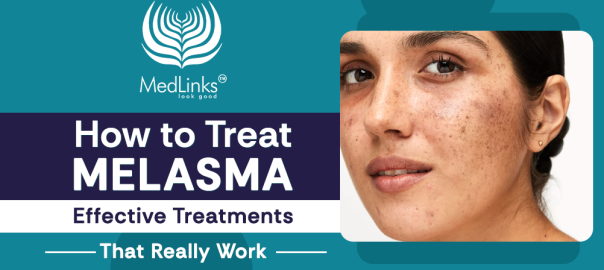
Melasma treatments usually work best when it is equipped as a plan instead of a single procedure. Care often starts with sun protection and prescription creams. Peels or laser treatment may be added based on pigment depth, skin type, triggers, and past response.
Melasma Rarely Has a One-Step Fix
Melasma can fade and return because pigment-making cells may become active again after sun or visible-light exposure. Some people do well with medical skincare alone, while others need a procedure.
First, Make Sure the Patches Are Melasma-Based
Melasma often causes brown or grey-brown patches on both sides of the face. This includes the cheeks, forehead, nose, chin, and jawline. Dermatologists may call it epidermal, dermal, or mixed, depending on how deep the pigment sits.
Other pigment problems can look similar. A skin examination, Wood’s lamp, or dermoscopy may help confirm the pattern.
Creams Often Come Before Procedures
Prescription creams reduce excess pigment over time. Hydroquinone lowers new melanin production, while some dermatologists use a triple-combination cream containing hydroquinone, tretinoin, and a corticosteroid.
Azelaic acid, kojic acid, vitamin C, and other pigment-control ingredients may also be used. Tranexamic acid may be considered when other treatment has not worked well enough. Oral tranexamic acid for melasma is off-label and needs medical assessment, especially in people with blood-clot risks.
Sun Protection Stays in the Plan
UV and visible light can increase pigmentation. The American Academy of Dermatology suggests broad-spectrum SPF 30 or higher. Tinted sunscreens with iron oxide also can protect against visible light, particularly for darker skin tones.
Peels Help, But Stronger Is Not Better
Superficial chemical peels with glycolic acid or salicylic acid could help surface-level pigmentation. They also can cause post-inflammatory hyperpigmentation, or darker marks after irritation. This risk is important in darker skin types.
Where Laser Treatment Fits
Laser treatment may help when melasma has not improved enough with other care. Low-fluence Q-switched Nd:YAG laser toning targets low energy and short pulses to pigment.
Aggressive or repeated treatment can cause post-inflammatory hyperpigmentation, loss of pigment, return of melasma, or melasma that becomes harder to treat.
MedLinks Tri-Beam Therapy
MedLinks uses Tri-Beam Q-switched Nd:YAG laser toning for pigmentation problems like melasma. The dermatologist examines the skin and selects the parameters and plan of treatment.
For people considering melasma treatment in Gurgaon, this keeps the laser within a dermatologist-led pigmentation plan.
How the Main Options Compare
| Treatment |
When it may be used |
Main limitation |
| Prescription creams |
Often the first treatment tried |
May cause skin irritation |
| Chemical peel |
When the pigment is closer to the skin surface |
May cause darker marks in some people |
| Laser toning |
When melasma has not improved enough with other treatment |
Pigmentation may return |
| Combination treatment |
When one treatment alone is not enough |
May take longer and need several treatments |
Prescription products may cause redness, scaling, or irritation. DermNet notes that mild redness or swelling after superficial peels usually settles within about 48 hours.
MedLinks states that Tri-Beam laser toning takes about 20 to 30 minutes with minimal downtime and may involve about four to six sessions, spaced several weeks apart. The American Academy of Dermatology states that overall melasma improvement may take about 3 to 12 months.
Some Patients Need a More Careful Plan
Pregnancy, irritated skin, past pigmentation after procedures, and certain medical risks can change treatment choices. Topical retinoids are not suitable during pregnancy, while oral tranexamic acid needs medical screening because of important blood-clot and heart-related risk factors.
Why Melasma Can Return
Treatment can reduce pigment without removing the skin’s tendency to make it. Good skin care and light protection can help manage flare-ups.
A dermatologist should assess the pigmentation before recommending a procedure. This matters in darker skin types because peels and lasers can cause post-inflammatory pigment changes.
If you are searching for the best skin doctor in Gurgaon for melasma, qualifications and pigmentation experience matter more than promises of permanent clearance.
Why Patients May Consider MedLinks
MedLinks provides medical and procedural pigmentation care under dermatologist supervision. Dr Pankaj Chaturvedi, Co-Founder of MedLinks, has MBBS & MD in Dermatology from AIIMS New Delhi.
We also have Tri-Beam Q-switched Nd:YAG laser toning available at MedLinks, Gurgaon, for some pigmentation issues like melasma. Treatment is adjusted after clinical assessment.
Frequently Asked Questions About Melasma Treatment
Q1. Can I wear makeup during melasma treatment?
Yes. Makeup can usually be worn during melasma treatment if the skin is comfortable and not irritated. After a peel or laser session, the skin may need time to settle, so ask your dermatologist when it is safe to restart makeup.
Q2. Can men have treatment for melasma for face pigmentation?
Yes. Men can receive treatment for melasma for face pigmentation. Treatment is chosen from the pigment pattern, skin type, triggers, and medical history, so the approach is based on the skin problem rather than the patient’s sex.
Q3. Can I wax or thread during melasma treatment?
Often yes, but timing matters during melasma treatment. Waxing can inflame the skin and may increase pigmentation in some people. If the skin is irritated or has recently had a procedure, ask your dermatologist when hair removal can be restarted.
Q4. Can melasma treatment help pigmentation above the upper lip?
Yes. Melasma treatment can help when the upper-lip pigmentation has been diagnosed as melasma. That area can also become dark for other reasons, so treatment should match the cause rather than treating every dark patch in the same way.
Q5. Can laser treatment for melasma be combined with Botox or fillers?
Sometimes. Laser treatment for melasma and injectable treatments can be planned around each other, but they treat different concerns. The timing depends on the procedures used and the condition of the skin. Botox and fillers do not treat melasma themselves.
Q6. Can I get melasma treatment if I also have active acne?
Yes. Melasma treatment can be planned alongside acne care. Active acne can leave new dark marks, so the dermatologist may choose products that manage both concerns without adding unnecessary irritation to skin that is already inflamed.